Guest Blogger: Jackie Manning, Owner of Bee Vibrations Breathwork, Breast Cancer Survivor, Go Jen Go Grantee
What if I told you there was a simple, gentle tool you carry with you every moment of every day that can help calm your body in times of stress?
That tool is your breath.
Breathwork is the practice of intentionally changing the way you breathe to support your physical, mental and emotional well being.
Check Point Question: So, you’re saying that by simply paying attention to how I breathe and making small, easy adjustments I can reduce anxiety, stress and improve my sleep?
Short Answer: YES!
There are thousands of different breathwork techniques that you’ve likely heard of, (I teach a lot of them myself), BUT if you are someone who is new to breathwork and in a state of panic, you likely aren’t going to be counting to four while you attempt to box breathe.
During my own cancer journey, there were times when it wasn’t feasible for me to breathe deeply from my diaphragm. Especially following a surgery where you are dealing with stitches and a limited range of motion.
It was during these moments that I remembered the very basic practice of breathwork is simply to observe your breath and breathe slowly.
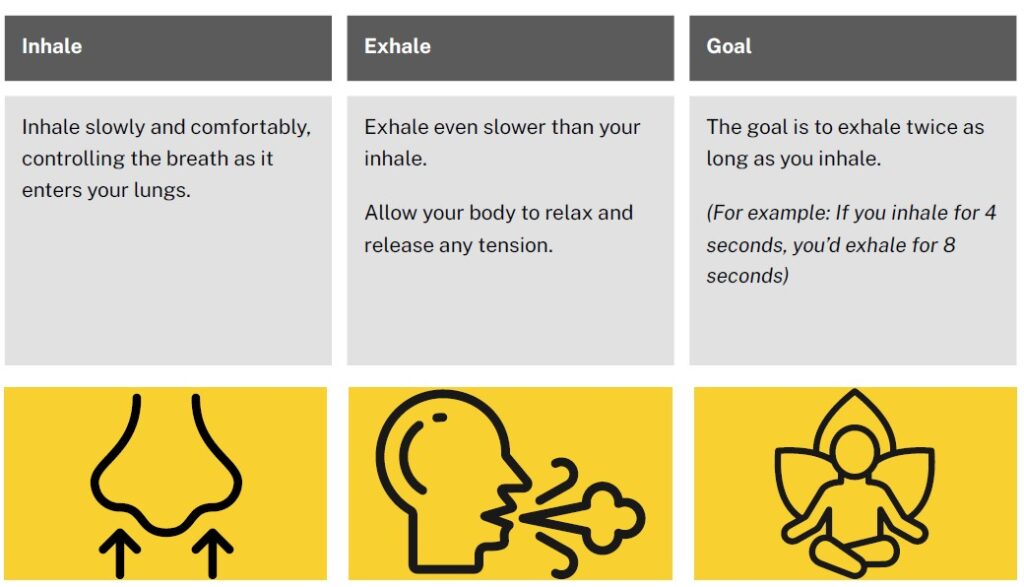
Lengthen Your Exhale.
One of the easiest ways to gently shift your body into a state of relaxation is by lengthening your exhale.
When you breathe out longer than you breathe in, you stimulate the vagus nerve, which sends a message to your body that it is safe to relax.
In plain terms? Your body starts to shift into a slower, steadier rhythm (parasympathetic). Your heart rate softens, your muscles unclench a bit, and your mind often follows suit.
No forcing, no perfect technique needed. Just a longer exhale than inhale – as if your breath is slowly letting go of a little more than it takes in.
Check Point Question: How does it all work?
When you breathe you use both your sympathetic, the part of your nervous system that makes you feel more alert, and parasympathetic, the part of your nervous system that makes you feel calm.
During inhalation, the sympathetic nervous system becomes slightly more active, causing heart rate to increase a bit while fresh oxygen enters the lungs and moves into the bloodstream. During exhalation, the parasympathetic nervous system becomes more active, slowing the heart rate while carbon dioxide is expelled from the body.
Slow, longer exhales help regulate carbon dioxide levels and activate the body’s calming nervous system, which signals the body to relax.
Reclaim Your Health.
There is so much I could say, write and teach regarding breath. There is a reason there are mountains of information regarding this subject, but for now, I just want you to get curious.
What more can you accomplish by learning the very basic mechanics of how your nervous system works with your breath?
The possibilities are truly endless. I know that when you go through periods of stress it’s easy to sometimes feel helpless. I know, because I’ve been there. That’s why I am so passionate about the work I do in teaching people how to empower themselves. You have a hidden superpower within you. Don’t take my word for it. Try it out and let me know how it goes!
About Jackie
Jackie is a certified breathwork facilitator and founder of Bee Vibrations Breathwork, offering evidence-based techniques that support nervous system regulation, stress reduction, and overall well-being. With training in medical Buteyko, Circular breathing, Pranayama and Reiki, she brings a practical compassionate approach to empowering clients to improve breathing patterns, manage stress, and build resilience.
Jackie works with individuals in both one-on-one and group settings, creating personalized experiences
tailored to each person’s needs. Contact her to learn more.